
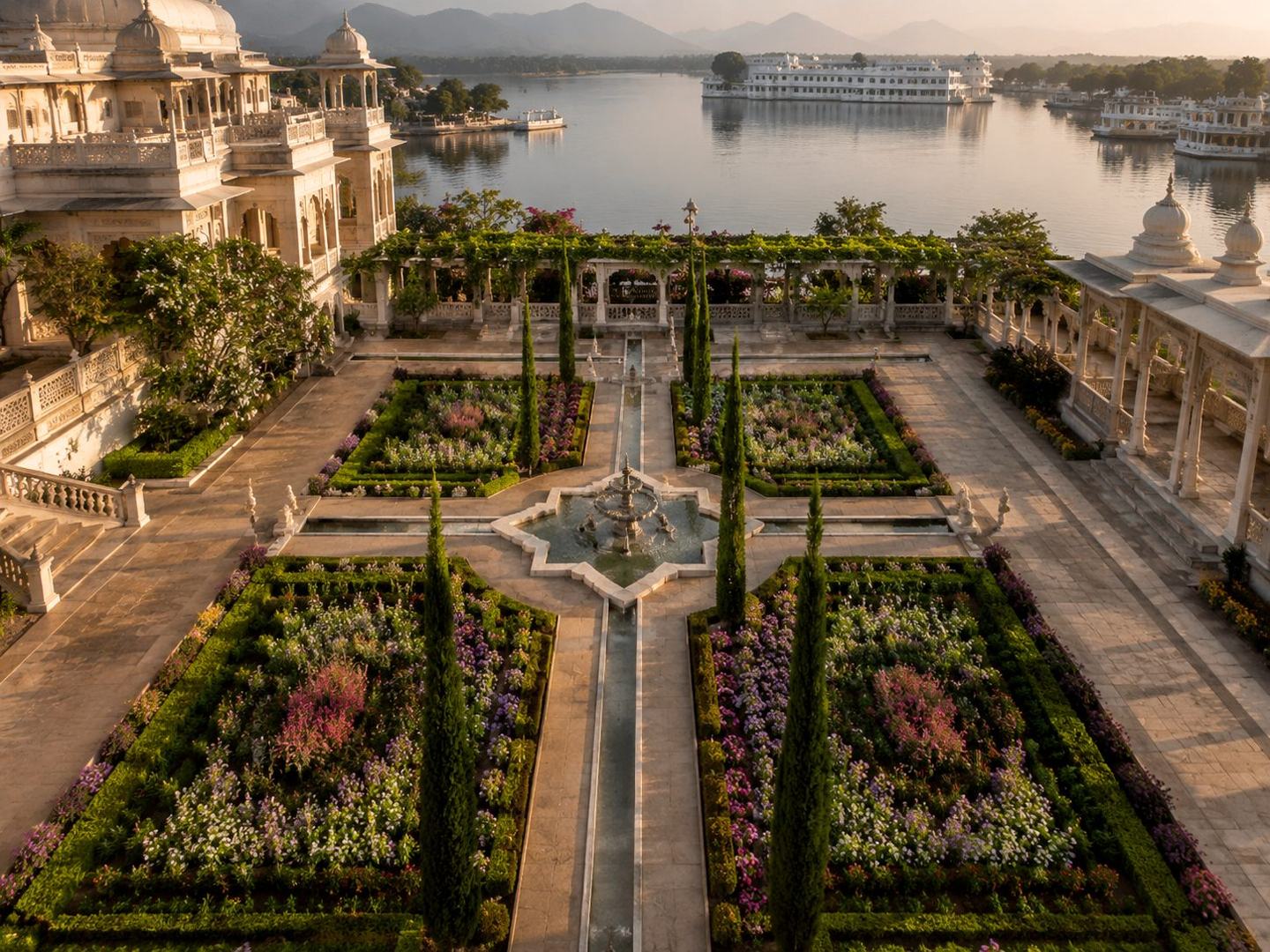
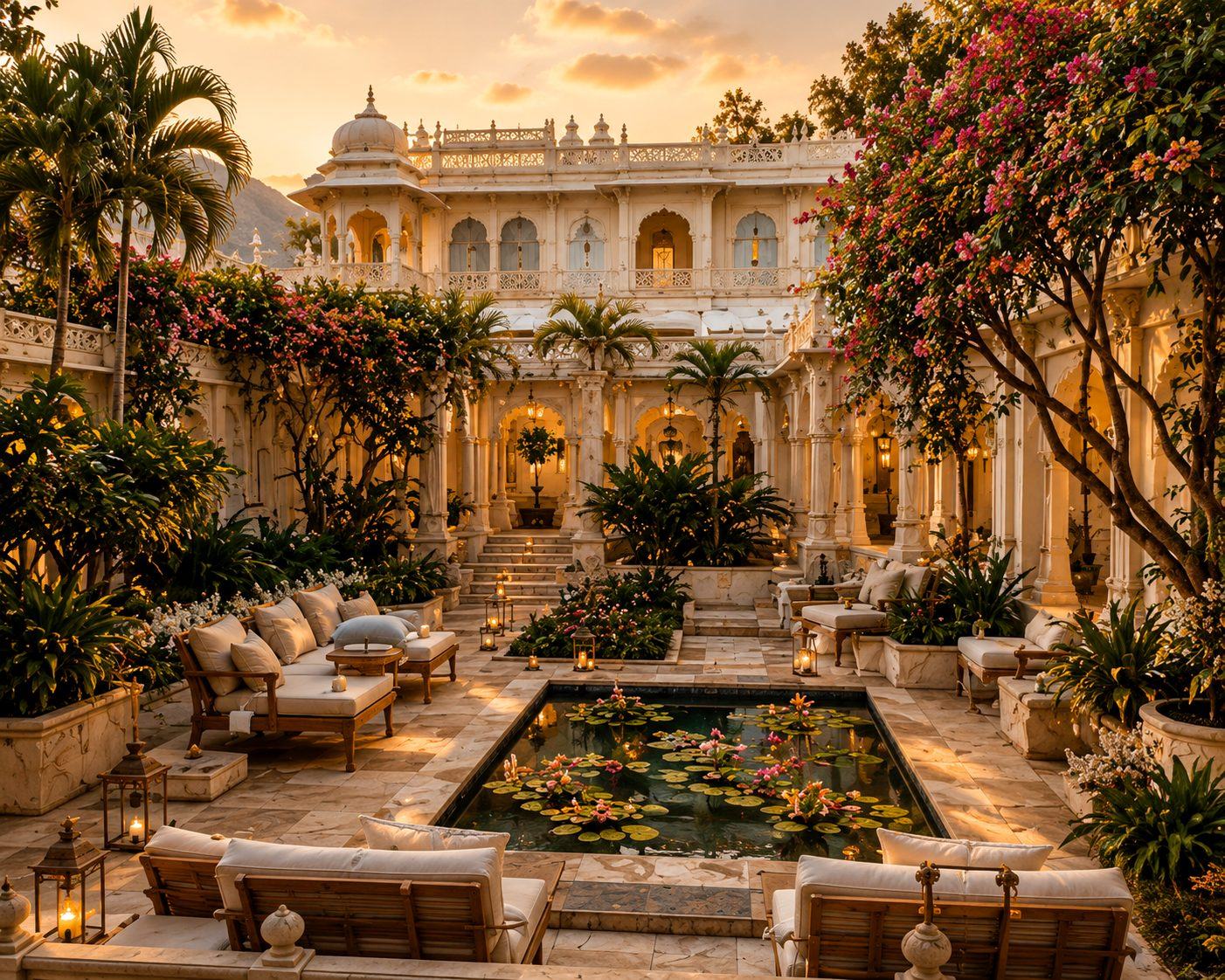
Planting composed in layers — canopy, understorey, shrub and groundcover — so a garden reads as one intention and grows richer every season.
Soft landscaping is the living part of a property: the trees, shrubs, groundcovers and flowering layers that turn built space into garden. Garden design, landscape gardening, planting design — the names vary from client to client; the work is the same, and we do it for hotels, estates and private homes across Udaipur and Rajasthan. At Nature's Touch we treat it with the rigour of a design practice — every specimen chosen for the site's light, soil and water, and set out to a drawn plan rather than assembled on the day.
We work most often for palaces, resorts and heritage hotels across India, where the planting has to look established from the opening day and hold its composure for years. That calls for a deep planting palette, honest soil preparation, and a maintenance plan written before the first plant goes in.
Every part, in-house.
- 01Site & soil survey
We read the ground first — horizons, drainage and light — before a single species is specified.
- 02Layered planting design
Canopy, understorey, shrub and groundcover composed as one drawn scheme.
- 03Climate-adapted palette
Species chosen for the local climate and water budget, so the garden thrives on less.
- 04Specimen selection
Trees and feature plants hand-picked at nursery for form and health.
- 05Soil preparation
Compost-led ground improvement that feeds the soil biology, not just the plant.
- 06Establishment care
A maintenance schedule that carries the scheme through its first vulnerable seasons.
How we work.
We begin with the ground. A soil and site survey tells us how deep roots can reach, where water sits, and which micro-climates the property holds. Only then do we draw the planting — in layers, so the garden has depth and shade from the first year and matures into something inevitable.
Our palette leans on species adapted to the region's heat and seasonal water, combined with the ornamental specimens a luxury property expects. The result is planting that looks generous without demanding constant irrigation or replacement.
Because we maintain what we plant, the design is honest about upkeep from the outset. Nothing is specified that the site — and the client's team — cannot realistically sustain.
Everything here begins with the soil, and the soil is difficult.
Most of the sites we work on around Udaipur sit on weathered Aravalli material — shallow, gravelly, sharply drained and low in organic matter, over rock that is often closer to the surface than anybody expects. Where the site has been levelled or built on, the topsoil has usually gone entirely and what remains is compacted subsoil and construction spoil.
Two consequences follow, and they explain most failed planting schemes in this region. The first is that water passes through faster than roots can take it up, so plants that should be drought-tolerant still fail in their first summer because they never established a deep enough root system. The second is that soils here tend to run alkaline and calcareous, which locks up iron and manganese and produces the yellowing between leaf veins that gets misdiagnosed as underwatering and then watered to death.
So we test before we plant, and we build soil rather than import a lorry of black earth and hope. That usually means deep cultivation to break the pan, bulk organic matter worked through the full rooting depth rather than dropped in the planting pit, and where the pH demands it, sulphur or an acidifying regime rather than repeated iron sprays that treat the symptom every year.
Planting into an unamended pit in compacted ground creates what is effectively a bucket — it fills in the monsoon, drowns the roots, and the plant that survives never leaves the pit it was planted in.
Planting in layers, not in beds.
We compose planting in four layers, and each does a job the others cannot.
The canopy sets the microclimate. In this climate that is not decoration — shade from a well-placed tree lowers the ground temperature beneath it materially, and everything planted under it needs less water for the rest of its life. Canopy decisions are the ones that are hardest to reverse and should be made first.
The understorey — small trees and large shrubs — gives the garden its structure at eye level and does the screening work. This is the layer that makes a garden feel enclosed and finished, and it is the layer most often left out when a scheme is value-engineered.
The shrub layer carries most of the flower and most of the seasonal change. It is also the layer that can be revised later without starting again, so it is where we take the interesting risks.
The groundcover is the one that repays itself fastest. Bare soil in Udaipur bakes, crusts and loses water. Covered soil holds moisture, stays cooler, and suppresses the weeds that otherwise consume a gardener's whole week.
What we plant, and why.
Canopy. Cassia fistula for the yellow in May, Delonix regia where there is room for it, Millettia pinnata (karanj) for reliable dense shade and a deep root that will not lift paving, and Ficus religiosa or Ficus benghalensis only where there is genuinely space and no building within reach of the roots. Azadirachta indica (neem) remains the most useful tree in this region and the most undervalued.
Understorey. Plumeria for sculpture and scent, Tabernaemontana divaricata for white flower in shade, Murraya paniculata as a hedge that will take clipping and still flower, and Thevetia peruviana where nothing else will hold.
Shrub. Bougainvillea in its shrub forms, Nerium oleander, Ixora coccinea, Hamelia patens, Duranta erecta for its golden forms and its willingness to be clipped, and Russelia equisetiformis spilling over edges and walls.
Groundcover. Wedelia trilobata where it can be contained, Alternanthera for colour blocks in formal work, ornamental grasses for movement, and mulch — coarse, deep and renewed — wherever planting has not yet closed over.
We also plant for pollinators as a matter of course rather than as an added feature, which is covered on the ecology section of the main site.
The most expensive thing in most gardens.
Lawn is the highest water demand, the highest labour demand and the highest input demand of anything we install, and in this climate that is worth saying plainly before it is drawn.
Cynodon dactylon (Bermuda, the common 'doob' selections) establishes fast, takes hard wear, and repairs itself. It wants full sun and it browns off in cold weather. It is the default for lawns that get walked on.
Zoysia is slower to establish and slower to repair, but denser once it is in, better in part shade, and noticeably lower in water and mowing demand once established. On estate and hotel work where the lawn is looked at more than it is used, it is usually the better long-term answer.
Paspalum vaginatum is worth specifying where the water available is brackish or the site is close to treated effluent reuse, because it tolerates salinity that would kill the alternatives.
What we most often recommend is simply less of it — lawn where people actually sit or play, and layered planting everywhere it was drawn only because the space had to be filled. That single change does more for a property's water bill than any irrigation specification, though the irrigation design matters too.
The first eighteen months decide the next twenty years.
A planting scheme is not finished when it is planted. It is finished when it is established, and in this climate that takes about eighteen months and two summers.
Through the first summer, watering is frequent and deliberately deep — shallow frequent watering trains roots to stay near the surface, which is precisely what kills a plant in its second May. Through the first monsoon we watch drainage, because that is when a soil problem announces itself. Through the first winter we prune formatively, while it still costs nothing to correct.
We also expect and plan for losses. A scheme with no failures in its first year has usually been over-watered and over-fed, and will be weaker at five years than one that lost a few plants and had them replaced. Our establishment contracts carry a defined replacement provision so this is an agreed position rather than an argument.
Asked often.
How long until a new garden looks established?
Groundcover and shrub layers read as filled in one to two growing seasons. The understorey takes three to four. Canopy trees are a ten-year proposition, which is why their placement is the decision we spend the most time on. Larger stock buys time at a cost and carries a higher failure rate.
Can you plant in summer?
We can, but we would rather not, and we will say so. The two windows that work in this region are just after the monsoon and again in the cooler months. Summer planting doubles the establishment water and materially raises losses. Where a handover date forces it, we plan for that rather than pretend otherwise.
Will this survive if the property runs low on water?
A layered, well-mulched scheme on properly prepared soil will hold through a bad season far better than the same plants in unamended ground. Lawn will not. If water security is a real concern, the honest answer is to reduce lawn area at design stage rather than to look for a miracle grass.
Do you use native plants?
Extensively, because in this climate they are usually the ones that work — neem, karanj, cassia and the native grasses do more with less. We are not doctrinaire about it. A garden at a heritage hotel has a look to hold, and some of that vocabulary is not native.
What happens after handover?
Establishment care is where schemes are won or lost, so we prefer to carry it ourselves for the first eighteen months under an estate maintenance agreement. Where a property has its own gardeners, we train them on the scheme and leave a written regime.
Do you do garden design for private homes as well as hotels?
Yes. The scale changes, the method does not: a site visit, a planting plan drawn to the soil and the sun, and a garden landscaping crew that plants it and comes back to keep it. Private gardens in Udaipur are a growing part of the studio’s work.
What is the difference between soft landscaping and landscaping design?
Landscaping design is the whole outdoor scheme — levels, paths, structures, water and planting. Soft landscaping is the planted, living part of it. We lead with the soft side and coordinate the rest, which is why our schemes are drawn around what will grow here rather than around the paving.
Soft Landscaping done properly pays for itself.
In a hot, water-scarce climate, planting that is chosen and prepared badly fails quietly and expensively. Layered, climate-adapted soft landscaping is the difference between a garden that is watered into survival and one that genuinely thrives — cooler courtyards, cleaner air, and a sense of arrival that photographs beautifully and lasts.
Enquire for your propertyRelated services
Planning soft landscaping for a hotel, resort or estate?
Tell us about the site and the season you're working towards. We'll arrange a survey and return a drawn plan.
Tell us about the site.
Every scheme begins with a survey. Send us the essentials and we will arrange one, then return a drawn plan — not a quotation against an assumption.
OR REACH US DIRECTLY