
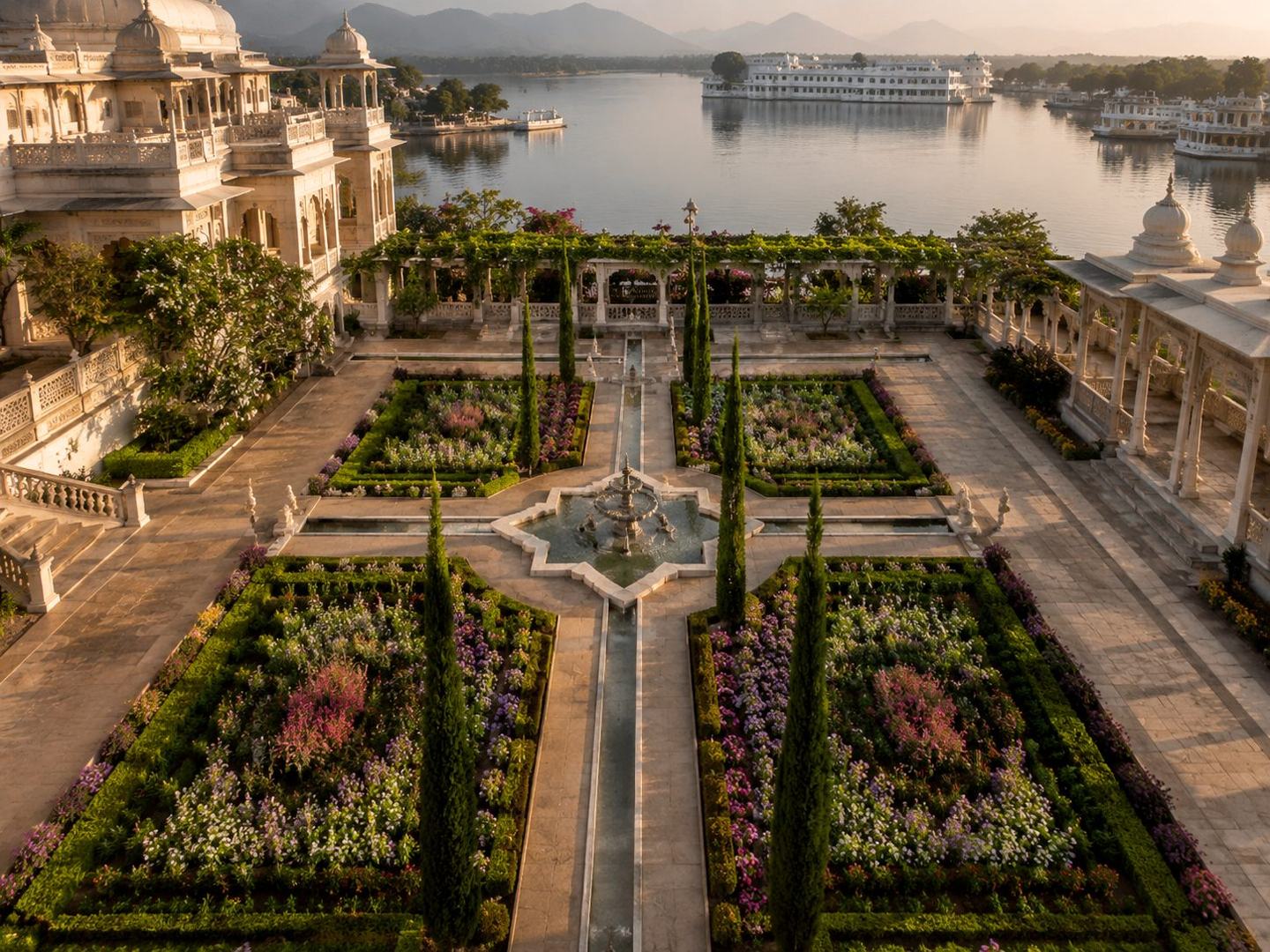
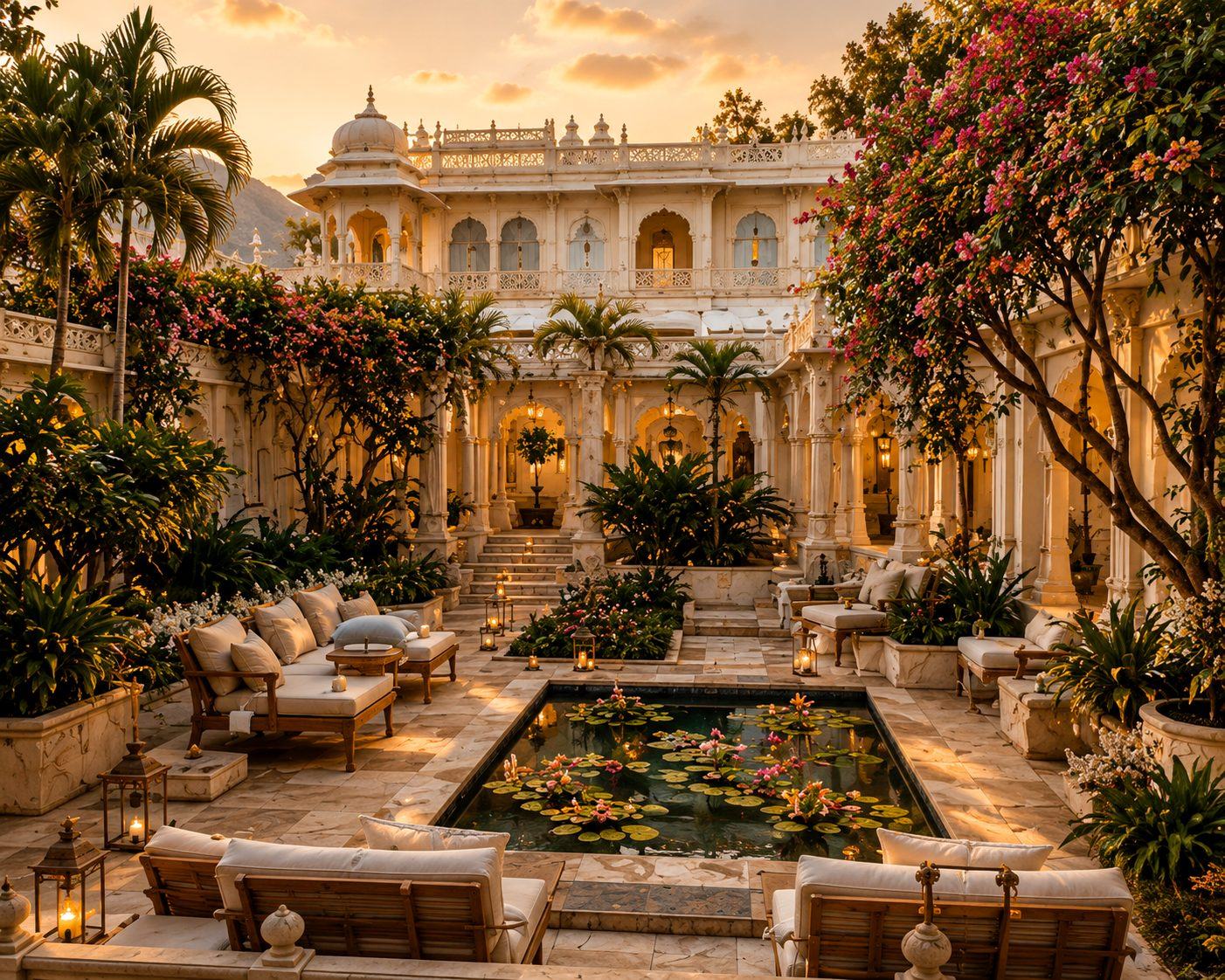
Structure, softened by flower — pergolas dressed in climbers until the frame all but disappears.
As pergola contractors in Udaipur we design, build and plant them ourselves — pergola design, structure and climbers from one studio. A pergola does two jobs at once: it gives welcome shade in a hot climate, and it gives the garden height, rhythm and a sense of arrival. Grown in with climbers, it becomes a living structure — cooler, scented, and quietly spectacular.
We design and plant pergolas and shade structures for walkways, courtyards and terraces where shade needs to be beautiful as well as practical.
Every part, in-house.
- 01Timber & steel structures
Well-detailed, durable frames designed for the climate and the load of mature climbers.
- 02Living green cover
Climbers chosen for shade, flower and scent, trained to clothe the structure.
- 03Shade & cooling design
Orientation and planting planned for real shade through the hottest hours.
- 04Scent & seasonality
Fragrant, seasonal climbers that make a walkway an experience.
- 05Integrated irrigation
Concealed watering that keeps climbers thriving at height.
- 06Training & upkeep
Ongoing pruning and training so the structure disappears into the planting.
How we work.
We design the structure and its planting together. The frame — timber or steel — is detailed to last and to carry the weight of mature climbers, and oriented for genuine shade when the sun is highest.
Onto it we train climbers chosen for cover, flower and scent, so the pergola cools, colours and perfumes the space beneath it. Irrigation is built in so the planting thrives at height.
With regular training and pruning, the structure gradually vanishes into green — which is the point. What began as a frame becomes a living, shaded room.
Most pergolas fail in the first three summers.
A pergola in Rajasthan is not the same object as a pergola in a temperate garden, and building one as though it were is the commonest reason they come apart. Four things account for almost every failure we are called in to correct.
Unseasoned timber. Timber that has not been properly seasoned will cup, split and twist within two summers here. The swing between a dry April afternoon and a humid August one is severe, and green timber simply moves. Members split along the grain, joints open, and the structure begins to rack.
Steel that was never detailed for heat. Mild steel conducts. An uninsulated steel pergola over a seating area can radiate heat downwards through the evening, which defeats the purpose entirely. Steel also expands, so a frame welded rigid at every junction with no allowance for movement will distort or tear at the welds.
Footings sized for the frame, not the planting. This is the one that catches most builders out. An empty pergola weighs very little. The same pergola carrying a mature bougainvillea after six years carries a great deal more, and it catches wind like a sail. Footings must be designed for the grown structure, not the built one.
Shade fabric as a substitute for shade design. Stretched HDPE cloth is a reasonable temporary measure. Under direct Rajasthan UV it becomes brittle, fades, and begins to shed within a few years, and it will need replacing repeatedly for as long as the structure stands.
Timber, steel or stone — and when each is right.
Seasoned hardwood gives the warmest result and the most forgiving surface for climbers to grip. It wants proper seasoning, an oil or preservative regime, and re-coating every two to three years. Where a client will not commit to that upkeep we say so rather than sell them the look.
Galvanised or powder-coated steel spans further on slimmer sections, which matters over a driveway or a wide walkway where intermediate columns would be unwelcome. It must be hot-dip galvanised or properly powder-coated — painted MS will bleed rust down the columns within a monsoon or two. Detail it with expansion allowance, and plan for the climber to cover it, because bare steel overhead is unpleasant in May.
Stone columns with a timber or steel top is the detail that sits most comfortably against Rajasthan architecture, and it is what we most often specify on heritage and hotel work. The masonry does the compression work and lasts indefinitely; the lighter top carries the planting. It costs more and takes longer, and on the right building it is the only version that looks like it belongs.
Climbers that actually hold up here.
A pergola is only as good as what grows on it, and the list of climbers that will genuinely thrive through a Udaipur summer is shorter than most planting schedules suggest.
For dense shade: Bougainvillea in its vigorous forms, Vernonia elaeagnifolia (curtain creeper) where a soft falling curtain is wanted, and Thunbergia grandiflora for large leaves and quick cover. Bougainvillea is the workhorse — it wants heat, tolerates poor soil, and flowers hardest when it is kept a little hungry.
For scent: Jasminum grandiflorum and Jasminum sambac near seating and along walkways, and Quisqualis indica (Rangoon creeper), which opens white and deepens to red over a few days and carries strongly in the evening. Scent is the reason to walk under a pergola rather than past it, and it should be planted where people slow down.
For flower: Petrea volubilis for its violet sprays, Pyrostegia venusta for a winter show, and Antigonon leptopus (coral vine), which is tough, quick and unfussy.
What we do not plant: wisteria, which wants a cold dormancy it will never get here; and, on any structure near a building, the more destructive figs. We also keep Antigonon and Thunbergia off structures that will not be pruned, because both will smother everything given the chance.
Shade at four o'clock, not at noon.
A pergola that shades perfectly at midday and not at all at five in the afternoon has been designed to the wrong hour. In Udaipur the uncomfortable part of a summer day is the long low sun from about three until sunset, when the angle is shallow and shade has to come from the sides rather than from overhead.
So the rafter direction, the spacing, and the planting density on each face are all set by which hours the space is actually used. A breakfast terrace and an evening bar want opposite answers. Where a structure has to work morning and evening both, we carry the planting down one flank rather than thickening the roof, which keeps the space bright without letting the low sun in.
Rafter spacing is the quiet variable. Closer spacing gives more shade from the frame itself and something for climbers to bridge; wider spacing gives a lighter structure and relies on the planting entirely, which means two or three seasons before it performs.
Where a pergola meets a waterproofed roof.
A pergola on a terrace is a different problem from a pergola in a garden, because every footing is a penetration through a waterproofing layer that somebody paid to get right.
Wherever possible we avoid penetration altogether and use weighted or spread bases that distribute load across the slab without breaking the membrane. Where the wind loading on a grown structure makes fixing unavoidable, the penetration is detailed, sleeved and flashed as a deliberate junction, and it is done before the terrace planting goes in rather than cut through afterwards.
The other constraint is load. A pergola with mature climbers, the soil to grow them in, and the water in that soil is a real imposed load on a slab that may have been designed for foot traffic. If we have not seen a structural drawing or had the slab assessed, we do not tell a client it will be fine. That is also covered on our terrace garden page.
What actually moves the number.
We do not publish rates, because a pergola is a made thing and the site decides most of it. But it is fair to say what the drivers are before anyone asks for a figure.
Span — the distance between supports drives section sizes faster than anything else. Removing one column can cost more than adding three.
Access — a courtyard reached through a building, or a rooftop with no hoist, changes the method and the programme.
Foundation conditions — rock is straightforward, made ground and expansive clay are not.
Finish level — the difference between a competent site-welded frame and a properly detailed, concealed-fixing structure is largely labour and largely visible.
Planting maturity at handover — a client who wants the pergola green on opening day is buying larger stock and a longer establishment regime than one who is content to wait two seasons.
Asked often.
How long before a pergola actually gives shade?
From the frame itself, immediately, and that is usually about a third of what the finished structure will give. From the planting, a vigorous bougainvillea or curtain creeper will cover meaningfully in two growing seasons and read as mature in three to four. Larger stock at planting shortens that, at a cost.
Timber or steel?
Steel if the span is long, the budget is finite, or nobody will commit to a maintenance regime. Timber if the pergola is close to where people sit and the warmth of it matters. Stone columns with a lighter top if the building is heritage or the client wants it to look inevitable rather than added.
Will the climbers damage the structure or the building?
Well-chosen climbers on a purpose-built frame, no. Climbers that root into mortar — the aggressive figs in particular — against an old wall, yes. We keep self-clinging species off masonry and train twiners onto wires and the frame, where they can be cut back without taking the building with them.
What maintenance does a pergola need?
Two prunings a year for most climbers, one hard and one tidying, plus training while growth is soft. Timber wants re-oiling every two to three years. Steel wants a look at the fixings after each monsoon. This is included in our estate maintenance contracts.
Can you build over an existing terrace or courtyard?
Usually. The questions are whether the slab can carry a grown structure, whether we can found it without breaking the waterproofing, and how we get material in. We answer those from a survey, not from photographs.
Do you work as a pergola contractor, or only design?
Both — we are the pergola contractor in Udaipur as well as the designer. The pergola design, the structure and the planting come from the same crew, which is the only way to guarantee the climbers were planned with the frame rather than added to it. We build in timber, steel and stone, on the ground and on waterproofed roofs.
Pergola & Shade done properly pays for itself.
In Udaipur's heat, shade is not a luxury but a necessity — and it can be beautiful. A living pergola turns a hot, exposed walk into a cool, scented, memorable arrival, and gives the garden the vertical structure that flat planting alone can never provide.
Enquire for your propertyRelated services
Planning pergola & shade for a hotel, resort or estate?
Tell us about the site and the season you're working towards. We'll arrange a survey and return a drawn plan.
Tell us about the site.
Every scheme begins with a survey. Send us the essentials and we will arrange one, then return a drawn plan — not a quotation against an assumption.
OR REACH US DIRECTLY